
Small Wedding Guest List: A Guide to Creating a Compact List
2026-06-01
Small Wedding Guest List: What It Means and Why Couples Choose It
Deciding who makes it onto your wedding guest list is one of the most personally challenging parts of wedding planning. It involves real relationships, family dynamics, and often a fair amount of guilt. Whether you are working with a tight budget, a small venue, or simply want a more intimate day, knowing how to cut your wedding guest list in a way that feels fair and considered makes the whole process easier. Here is a practical guide to help you work through it.
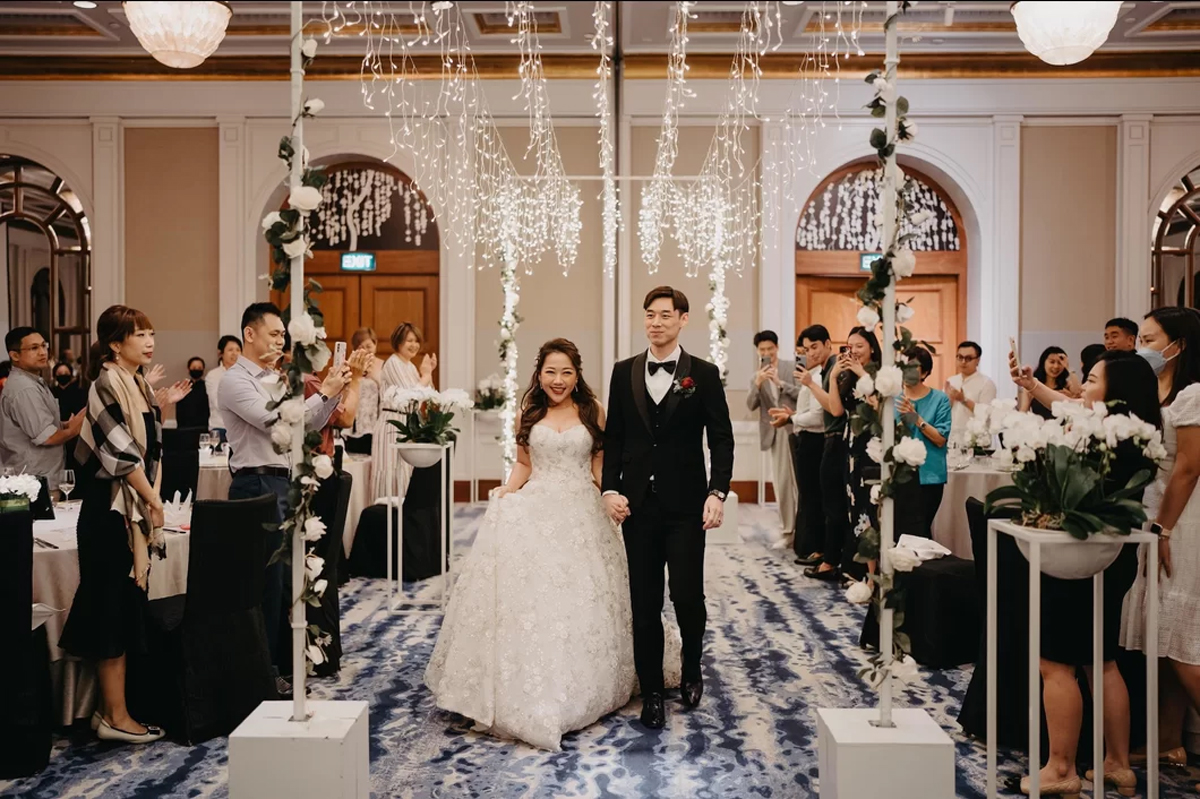
Source: labellecouture
A small wedding guest list typically refers to a guest count of 50 people or fewer, though some couples use the term for anything under 80. Micro-weddings, which have grown in popularity, usually involve 20 guests or fewer. Intimate weddings generally fall in the 20 to 50 range, and small weddings sit somewhere between 50 and 80 depending on who you ask.
Couples choose smaller weddings for a variety of practical and personal reasons. The most common is budget. A lower guest count means lower catering costs, smaller venue requirements, fewer favours, and less overall expenditure. But many couples also simply prefer the atmosphere of a smaller gathering. When you are surrounded by only your closest people, the day tends to feel more relaxed, more personal, and more present.
The differences between a small and large wedding go beyond numbers. A large wedding above 100 guests involves more complex logistics, longer seating plans, higher vendor costs, and a faster-paced day. A small wedding allows for longer conversations, more flexibility with venue type, and often a higher quality experience per guest. The trade-off is that smaller guest lists require harder decisions upfront about who to include.
Why You May Need to Cut Your Wedding Guest List
There are several common reasons couples find themselves needing to reduce their guest list after an initial draft.
Budget constraints are the most straightforward. Catering is typically one of the largest single costs in a wedding, and it scales directly with your guest count. If your per-head cost is $150 and your list has 120 names on it, that is $18,000 on food and drink alone before any other costs are factored in. Cutting 30 guests saves $4,500 immediately.
Venue capacity is another hard limit. Many of the most sought-after venues, particularly boutique spaces, heritage buildings, and private properties, have strict capacity restrictions. If your preferred venue holds 60 guests and your list has 95 names, something has to give.
Personal preference and wedding style also play a role. Some couples start the planning process imagining a large celebration and gradually realise that what they actually want is something quieter and more considered. There is nothing wrong with adjusting your plans as your vision becomes clearer.
A guest list also becomes too large when it starts being driven by obligation rather than genuine desire. If more than a quarter of your list consists of people you feel you have to invite rather than people you want there, that is a sign the list needs revisiting.
How to Decide Who Stays and Who Goes
The hardest part of cutting a wedding guest list is not the logistics. It is the emotional weight of making decisions about real relationships. Having clear criteria helps remove some of the subjectivity.
A simple test many couples find useful: would you be genuinely sad if this person could not attend? If the honest answer is no, that is useful information.
Prioritise close relationships first. Immediate family, your wedding party, and your closest friends are your core list. These are the people who belong at your wedding regardless of other constraints.
Be consistent with distant relatives. If you decide not to invite second cousins, apply that rule to both sides of the family. Inconsistency causes more friction than the decision itself.
Colleagues and acquaintances are generally the first category to reconsider. Unless you socialise with them regularly outside of work, a colleague is usually an optional guest. The same applies to people you were once close to but have naturally drifted from over the years.
Core guests vs optional guests: Think of your list in two tiers. Core guests are people who would notice and feel their absence from your wedding. Optional guests are people you like and would welcome, but whose presence is not essential to the day. When you need to reduce numbers, you work from the optional tier downward.
See more: Who To Invite To Your Wedding
Step-by-Step Process to Reduce Your Wedding Guest List
A structured approach makes the process more manageable and less emotionally draining.
Step 1: Write your full draft list. Include everyone you might conceivably invite with no filtering at this stage. Getting it all out first gives you a clear picture of where you are starting from.
Step 2: Group guests into categories. Divide your list into immediate family, extended family, close friends, wider social circle, colleagues, and others. This makes patterns visible and decisions easier.
Step 3: Rank by priority and relationship. Within each category, order guests by how close the relationship is and how much their presence matters to you personally.
Step 4: Apply your limits. Set your maximum guest count based on your venue capacity and budget. Work down your prioritised list until you hit that number.
Step 5: Trim and finalise. Remove guests from the bottom of your optional categories first. Review the remaining list and check that the cuts feel consistent and fair across both sides of the family and your social circles.
Give yourself a day or two before treating the list as final. Decisions made in a calmer moment tend to hold up better than those made in the middle of a stressful planning session.
Practical Strategies to Cut Down Your Wedding Guest List
Beyond the general process, there are specific strategies that help when you need to narrow down your wedding guest list further.
Limit plus-ones. Offering a plus-one to every guest can add 20 to 30 extra people to your list quickly. A practical rule is to extend plus-ones only to guests who are married, engaged, or in a long-term established relationship. Apply this consistently across your entire list.
Host an adults-only wedding. Children are often overlooked when counting heads, but if you have a large extended family, children can account for 15 to 20 additional guests. An adults-only wedding is a widely accepted choice and most parents appreciate the opportunity for a night out.
Remove distant connections. People you have not seen or spoken to in more than two years, distant relatives you have no ongoing relationship with, and former colleagues you are no longer close to are all reasonable candidates for removal.
Split your events. One option is to have a small ceremony with only your closest people and a larger, more casual celebration afterwards, such as a garden party or dinner, for a wider circle. This allows you to honour different relationships without blowing your main event budget.
See more: Common Wedding Guest List Dilemmas
Balancing Guest Count with Budget and Venue
Understanding the financial impact of each guest makes it easier to have honest conversations about your list.
Calculate your per-head cost by adding up catering, drinks, favours, stationery, and any per-person venue charges, then dividing by your guest count. This gives you a clear number to work with. Every guest you remove saves you that amount. Every guest you add costs you that amount.
Match your guest list to your venue size deliberately. A venue that holds 100 guests but has 60 people in it can feel sparse. A venue that holds exactly your guest count feels right. Choosing a venue that fits your actual numbers rather than your aspirational numbers is a more practical approach.
The trade-off between experience and size is worth thinking about honestly. A smaller guest list often means you can spend more per person on food, drink, and overall experience. Many couples who chose a smaller wedding report that the quality of the day, and their ability to actually spend time with each guest, was significantly better than it would have been at a larger event.

Common Mistakes When Cutting a Wedding Guest List
Knowing what to avoid is just as useful as knowing what to do.
Cutting too late. Leaving your guest list decisions until after save-the-dates or invitations have gone out creates significantly more awkwardness. Make your cuts before any communication goes to guests.
Being inconsistent with your criteria. If you invite one second cousin but not others, or offer a plus-one to one friend but not another in the same situation, you will create more friction than if you had simply applied a clear rule from the start.
Letting others control your list. Well-meaning family members can apply a lot of pressure around guest lists. Being receptive to input is reasonable. Handing over control of your list is not. It is your wedding.
Over-inviting just in case. Some couples add people to the list assuming they will decline. This is a risky approach. If everyone says yes, you are over capacity and over budget. Only invite people you would genuinely be happy to have attend.
See more: What Not To Wear To A Wedding
Alternatives to Cutting Your Guest List
If reducing your list feels too difficult, there are structural alternatives worth considering.
Host multiple smaller events. A small ceremony followed by separate celebrations with different groups, such as a family lunch and a friends dinner, allows you to include more people without exceeding your venue or budget limits at any single event.
Live stream your wedding. For guests who live far away or cannot attend in person, a live stream is an increasingly common and well-received option. It allows people to feel included without adding to your headcount.
Send announcements instead of invitations. For acquaintances and wider connections you want to inform but cannot invite, a wedding announcement sent after the event is a perfectly acceptable alternative to an invitation. It shares the news without implying they were considered and cut.
Consider a hybrid wedding. A hybrid format combines a small in-person ceremony with a larger virtual attendance option. This works particularly well when you have guests in multiple countries or when your venue capacity is genuinely limited but your social circle is wide.
Knowing how to limit your wedding guest list is ultimately about being clear on what matters most to you on the day, and making decisions that reflect that rather than decisions driven purely by obligation or social pressure. A smaller, well-considered guest list almost always results in a more enjoyable and personal experience for everyone involved.
Request a quote from over 450 wedding vendors
Get A Free Quote Now




Editor's Choice Awards 2026

GET THE APP


WE ACCEPT






Copyright © 2026 Citrus Media Pte. Ltd.
Reg No.: 200206092Z. All Rights Reserved